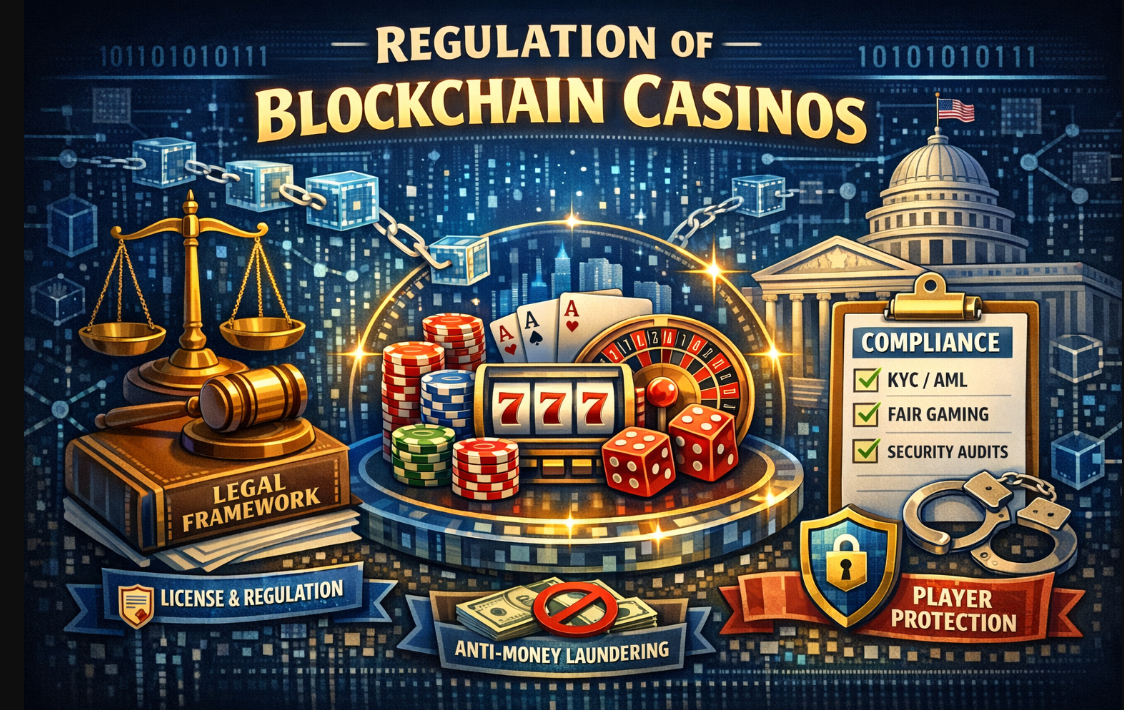
As decentralized gambling platforms continue to spread within global markets, the regulation of blockchain casinos has become increasingly important. These platforms are different from conventional casinos as they utilize blockchain technology, which provides transparency, but also provides legal challenges.
Regulators and governments try to mitigate the challenges of fraud, data privacy, and other Financial security concerns, which are also important to the protection of consumers. For both gambling operators and players, the evolving regulations are critical to understand, especially as they continue to focus on crypto-based gambling.
What Are Blockchain Casinos?
Gambling sites that use crypto and blockchain technology instead of traditional banking systems are called blockchain casinos. Such casinos do not rely on traditional banking methods. Instead, they use decentralized technology and smart contracts to process and manage games, betting, and payout.

Therefore, instead of using ‘blind trust’ to trust the casino, they use the technology called blockchain, which provides every player with the capability of ensuring the fairness of the game result.
This technology is called ‘provably fair gaming’. Players use cryptographic mechanisms to secure their game results.This technology is called ‘provably fair gaming’. Players use cryptographic mechanisms to secure their game results.
Blockchain casinos operational model
Automated betting on a blockchain casino is performed through smart contracts. Smart contracts are pre-defined, and the casino does not analyze the game. The results are automatically calculated, and payments are automatically made according to the rules defined in the smart contract.
Why They Are Becoming More Popular
The reasons for their growing popularity include an increase in trust, cheaper fees, worldwide reach, more control over your money, and blockchain’s growing adoption. These factors help these online gaming sites lead the innovation in the online gaming industry.
Why Regulation Is Necessary
Fraud Prevention
Regulations require crypto casinos to create policies pertaining to fraud and abuse related to player exploitation.
Trustworthiness of Games
Trustworthy and verifiable systems are mandated to be used in all games. These include audits and provably fair systems as well as RNG systems.
Financial Crime Prevention
Regulatory frameworks surrounding crypto casinos require the implementation of KYC and AML policies which aid in the prevention of financial crimes and fraud.
Protecting Players and Responsible Gaming
Regulations also require casinos to offer players facilities designed to help control their gambling behaviors and avoid the development of gambling addiction. These facilities include self-exclusion options, deposit limits, and the ability to monitor player behavior.
Transparency
Regulations also help casinos to be more transparent about their general practices, including the odds of their games, and the fees involved which helps build trust with players.
Legal Accountability
Regulations also help casinos to be more transparent about their general practices, including the odds of their games, and the fees involved which helps build trust with players.
Supporting Market Stability
By extending the framework of the regulations, businesses of all kinds can operate in a legitimized space, scams can be contained, and sustainable and inclusive growth can be achieved. This is beneficial for both the operators and the users in the long run.
Global Regulatory Landscape in 2026
United States
Regulations in the United States are uniformed and inconsistent as certain States have made laws to permit online gambling and betting over crypto and some have even restricted the action. This presents the need for operators to manage and work with diverse laws in their jurisdiction.
European Union
In the European Union there are strict consumer protection and anti money laundering laws as well as data protection and privacy laws. While the compliance and protection laws are harmonized, the gambling laws still leave a lot to be desired.
United Kingdom
Licensing and regulation for responsible gambling and advertising have been some of the major additions to the United Kingdom gambling laws. Along with the rest of the EU, the UK has seen tightening of rules on advertising and sponsorship of gambling and crypto related activities.
Asia-Pacific Region
In the Asia-Pacific region, the gambling laws are very diverse as it can be very permissive in countries like Japan and Australia and very restrictive in other countries. This presents a very diverse environment for regulating crypto casinos.
Middle East
The middle east has strong legal and cultural implications for the prohibition of gambling in many of the countries. However, there are some areas that are open to regulation of fintech and the blockchain, although they do not allow crypto gambling.
Latin America
The lack of clear regulations and evolving legal frameworks creates opportunities for online gambling and crypto in many of the Latin American countries.
Africa
Even though some countries within the continent have started developing regulations around online and crypto gambling, most have a significant lack of regulations. This both creates opportunities, and risks from a regulation standpoint.
Key Regulatory Trends in 2026
Calls for Greater Transparency in AI Algorithms
Regulators are requesting more transparency on how Artificial Intelligence constructs their algorithms and are demanding that platforms detail the reasoning behind their decisions, how the odds are calculated, and how data is used.
Scope of Regulations on Cryptocurrency Broadens
New laws are being introduced on the use of cryptocurrencies which include licensing, taxation, and digital assets used for gambling.
AML and KYC Regulations Will Be Enforced More Stringently
Platforms will be required to enhance user verification and monitoring systems for legal and regulatory compliance to combat illicit transactions.
Regulations on the Use of Personal Data
Regulations will be introduced on how user data is stored and used. Platforms will be required to minimize the collection of user data and to document data collection practices.
More Cross Jurisdictional Collaboration among Regulatory Bodies
More international cooperation is anticipated for regulatory jurisdictions to combat the challenges of inconsistent regulatory frameworks in transnational gambling for crypto.
Increased Focus on Policies for Responsible gambling
Regulators are expected to require the use of AI to develop and implement tools for gambling addiction, behavioral monitoring, and self-exclusion.
Licensing and Compliance Expansion
Various jurisdictions are increasingly implementing licensing frameworks for crypto casinos. These frameworks require casinos to comply with operational, financial, and security requirements before servicing users legally.
Role of Governments and Regulatory Bodies
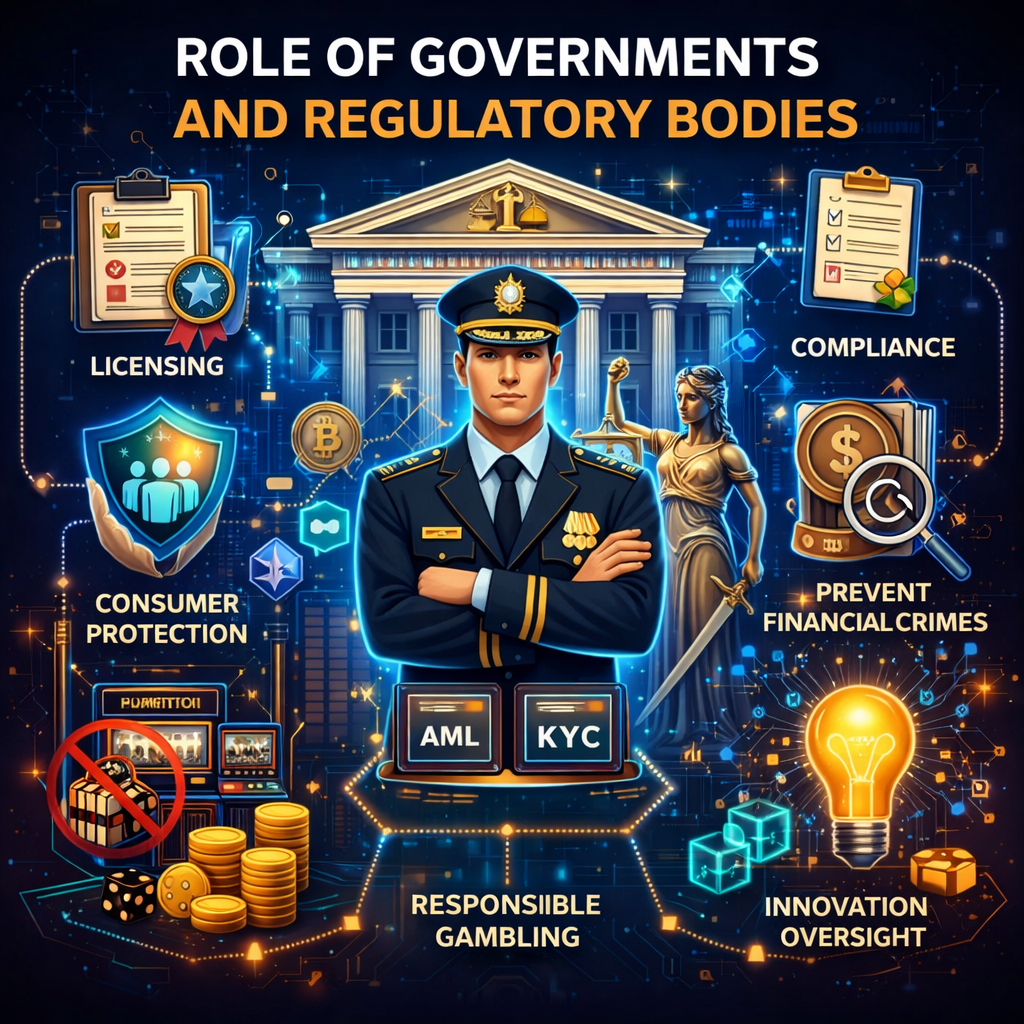
Legal Boundaries for Crypto Casinos
Governments create legal boundaries for crypto casinos regarding their legality, taxation, licensing, and operational parameters. There are legal and illegal ways that casinos can operate, and governments create legislation to guide how casinos can legally operate.
Licensing
Regulatory authorities assess operators’ financial viability, security mechanisms, and fairness before signing off on licenses. Only legal and compliant casinos may offer gambling services.
Compliance Checks
Regulatory authorities conduct compliance checks, audits, and operational reviews on casinos. Casinos can have their casinos closed, or licenses revoked if there are operational failures or law violations to preserve the casino industry.
Consumer Protection
Regulators provide consumer protection against gaming fraud, unfair gaming practices, and financial consumer exploitation through the implementation of fair gaming rules, disputes resolution mechanisms, and transparent gaming practices.
Crime Prevention
Governments implement the KYC and AML principles to reduce the possibility of user identity fraud, money laundering, and other criminal financial acts in gaming operations.
Gaming Responsibility
Regulatory authorities impose mechanisms to monitor consumer behavior, set gaming deposit limits, and enable self-exclusion to manage gaming addiction and promote safe gaming practices.
Supporting Innovation with Oversight
The government has granted the option to develop technology in the fields of AI and blockchain. However, there are some regulations in place to ensure that the innovation is harnessed with regard to the safety, fairness, and trust of the public.
6.Challenges in Regulating Blockchain Casinos
No Control and Decentralization
Most blockchain casinos operate with no central authority and that greatly hinders the ability of regulators to control and enforce rules, monitor activities, or take action against non-compliant sites that operate in multiple jurisdictions.
Borderless Websites
These sites are open to users from all countries, and because they all have different laws, and because jurisdictions operate with little to no cooperation, enforcement becomes quite difficult.
User Anonymity
The user anonymity offered through cryptocurrency and the difficulty in enforcing KYC in addition to the difficulty in detecting fraud, money laundering, and other illicit activities makes the regulator’s job near impossible.
Evolving Technology
The rapid development of blockchain and AI means they evolve at a pace that is harmful to any potential regulatory oversight as regulators are almost always playing catch-up.
Issues with Smart Contracts
The financial costs associated with the exploitation of vulnerabilities or mistakes in smart contracts can be severe and in addition, the decentralized nature of the contracts means that regulation, mitigation, or oversight become impossible.
Low Knowledge of Regulators
A lack of understanding of the applicable regulation of blockchain and AI systems means they can’t be audited, compliant, or reviewed in a meaningful way.
Enforcement Challenges
Even if some regulations may exist, their enforcement may remain challenging due to a lack of centralised control, absence of a physical entity, and challenges of pinpointing accountability within the behind-the-platform actors.Impact on Players and Operators
Improved User Experience for Players
Operators engaging AI helps make users experience more personalized helps increase the length of users time spent on the site using seamless interfaces made using AI. Along with users AI helps make transactions seamless and increases user experience by providing help customer support.
Improved Operational Effectiveness for Operators
Automated fraud AI detects and helps eliminate fraud. Additionally, automated customer support helps reduce the need for human resources.
Improved Trust and Transparency
Transparent transactions drive trust in operators and improved user experience drives trust in users. Operators and users trust each other when both perceive that fair verification improves trust and transparency.
Improved Trust and Transparency
Operators implement AI in unclaims, fraud, hacking, and secrets secur. when operators implement secrets to protect data, hacking, fraud seekers. Players get more data, fewer secrets, and increased trust.
Evolving Player Patters
Dynamic systems change player strategies. AI integrated systems and operators modify algorythms to balance risk and fair player perception of the system and ownership of the game.
Evolving Regulatroy Pressure
Because the systems of operators become more complex, the systems of players become more protected and trusted under law. Legal regulations become more trusted with data protection and player safety systems.
Responsible Gambling Implications
Gambling operators must develop responsible gambling tools that promote ethical gambling and prevent gambling addiction. Self-regulation and self-control will be required for users as AI powered engagement can lead to increased playtime.
Compliance Requirements for Blockchain Casinos
Licensing & Legal Approval
Companies launching platforms forBlockchain casinos must secure adequate proof of legal and regulatory compliance, operational, and financial licenses from relevant jurisdictions.
Anti-Money Laundering (AML) Compliance
All systems, including payment processors, must be capable of overseeing, recording, and reporting all transactions to identify and report instances of potential money laundering, ensuring that all systems are clear and comply with regulatory obligations at the global level.
Know Your Customer (KYC) Compliance
KYC compliance must be implemented in all casinos for identity verification to offset the ability to commit fraud or illegal acts, including underage gambling in a digital environment.
Privacy/Data Protection Compliance
All operators must comply with relevant data protection laws, including the appropriate and secure retention and usage of personal and financial data of the users.
Fair Gaming Policies with RNG
All platforms must have regular and appropriate reckonings of fair play to have integrity and compliance with fair play in addition to Fair, and Random Number Generators, and Demonstrably Fair Play systems.
Audit of Smart Contracts
Audit for security must be performed on all smart contracts to find and address all potential vulnerabilities, protecting the integrity of the code, and preventing the manipulation of automated betting and payout systems.
Responsible Gaming Initiatives
In line with regulations to combat gambling addiction and protect at-risk customers, casinos offer self-exclusion, deposit limits, and self-check tools, and have installed systems to monitor gambling behaviors.
Future Outlook
More AI Centric Automation
More automation of operations within casinos will be seen, as AI will be employed to further automate tasks such as setting odds, detecting fraud, and performing customer service. AI will also allow company costs to be lowered, and business scalability to improve globally with little human involvement as operations will need less human involvement.
More Decentralized Casinos
December casinos will increase, as blockchain based casinos will allow more community based casinos to be created. Also blockchain based casinos will allow more users to govern within the casinos as well as increase transparency and lessen the need for centralized operators.
Greater Regulations Globally
There will be more regulation for crypto casinos, as governments will outline and clarify more rules regarding the protection of consumers, the taxation of casinos, and the compliance with rules of casinos. More regulation will provide more trust within the industry.
Improved Personalization Technology
More refined and improved systems of personalization will really be felt. Users will be able to receive this service in the more tailored gaming experiences, and in user interfaces. Personalization will increase users engagement and will also increase ethical issues and privacy concerns.
Adoption of More Technologies
It is expected that the more futuristic forms of technology will accompany blockchain based casinos. These include virtual reality, augmented reality, and the metaverse gaming. With the use of these technologies, gaming will be able to be more immersive, and users might have a new way to use gambling-linked digital technologies.
More Safety and Risk Management
With caveat that systems will be using more improved systems of AI, it is likely that there will be less fraud, less threat, less risk, and risk will be better managed. Less fraud will be seen, and the safety of players and casino operators will be improved.
Innovation in Game Design
Game mechanics will become adaptive and intelligent, which will facilitate new, dynamic, player behavior-based gameplay experiences and new interactive, engaging casino games.
Conclusion
The forecast for 2026 suggests a slightly alarming trend for regulation involving blockchain casinos as there has been a correlation to an increase in global harmonization of regulation in a more strict fashion. More and more jurisdictions are developing regulatory frameworks for licensing crypto and KYC and AML regulatory frameworks have become a requirement across a number of regulated jurisdictions. These developments in large part are an attempt to provide more protection to users, more transparency, and to combat the rising fraud across the fast-paced developing configurable markets.
Decentralized blockchain casinos will continue to provide challenges to the entire regulatory systems of the jurisdictions of the operators as the casinos are fully autonomous and operate borderless, privately, and anonymously. As such, there are a number of jurisdictions that are utilizing technological development such as artificial intelligence and blockchain to provide regulatory oversight and enforcement to support the technology.
The most salient point that can be observed within the global developments is that the more regulation there is, the greater the opportunity for the industry to innovate and grow. Given the new developments, the industry will be able to provide more regulatory protection to its users and eliminate the regulatory obstacles that have provided, and will continue to provide, restraints in the development. More so, the global regulatory climate will provide an opportunity for the operators to develop and refine their products to provide an even more enjoyable experience to the users and increase the need for the users to regulate and the industry to provide users with a regulated environment for their activities.
FAQ
Regulation helps prevent fraud, ensures fair gameplay, protects users, and reduces risks like money laundering. It also builds trust between players and operators.
Many regulated platforms now require KYC (Know Your Customer) verification to comply with global laws. However, some decentralized platforms still offer limited or no KYC.
Governments regulate centralized aspects like operators, payment gateways, and user access. Fully decentralized platforms are harder to control, creating ongoing regulatory challenges.
They can be safer due to transparency and provably fair systems, but risks still exist—especially on unregulated platforms. Regulation plays a key role in improving safety.
Major challenges include cross-border jurisdiction issues, anonymous transactions, rapid technological changes, and enforcing laws on decentralized systems.